

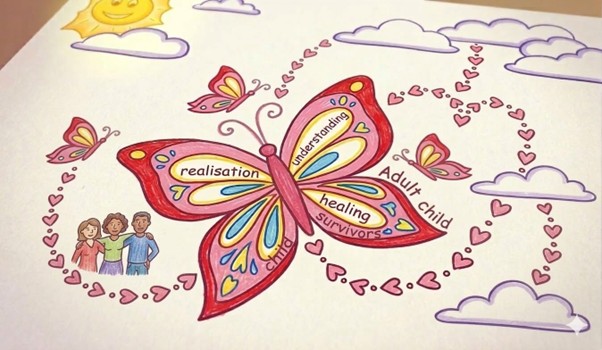
 Hopes for brighter days, a happy home, and a peaceful environment watching nature (the beautiful pink love butterfly)
Summary: This article explores how Photo Elicitation (PE) serves a dual purpose: as a tool for gathering information, and as a gentle pathway to healing for adults who grew up in abusive homes. Rather than just adding detail to a story, the act of engaging with photos often triggers a transformative epiphany. This is a profound moment where a survivor stops seeing themselves as a passive witness to their past, and begins to actively ‘re-author’ their own life story. As well as being a researcher, I’ve also participated in several studies on childhood domestic abuse, including as a member of the older ‘young’ category of survivors. The benefits of participation at a later age confirm that it’s never too late to understand your own journey, and that it’s vital for such studies to include adult child survivors.
Quiet Echoes: Recognising and Including the Adult Survivor
When a child grows up in a home shaped by domestic abuse, they aren’t bystanders to someone else’s story; they are living their own. These early experiences are more than just memories—they are Adverse Childhood Experiences (ACEs) that can leave a lasting imprint on a person’s physical health and emotional well-being, long after they’ve reached adulthood.
Recent research, including the Drake IPV Study (2025), shows us that the echoes of childhood trauma don’t necessarily fade with time. For many, the weight of depression, anxiety or PTSD can remain or become a significant part of their daily lives, decades after the abuse has stopped. It is a testament to their strength that they continue to move forward, even while carrying the invisible burden of a past they didn’t choose.
Realisation Through Photos
I participated in a study on young people’s experiences of family violence—young people who had at some point in their childhood or adolescence lived in a home where there was domestic abuse.
Though I entered the study aged 30, the researchers understood the value of an ‘older’ perspective, as they acknowledged that the echoes of childhood trauma persist into adulthood (Dye, 2018; Herzog and Schmahl, 2018). Including adult voices offers a rare longitudinal lens, allowing researchers to trace the ‘weathering’ effects of trauma over decades. As Hague et al. (2012) poignantly observe, many adult children remain ‘still forgotten, still hurting’—and this study actively sought to end that silence.
The research used a creative approach to help us express things that might be hard to put into words:
Capturing the Journey
We were asked to take 5-10 photographs via our mobile phone, digital camera, or use existing photographs that reflected our experiences of living in a violent/abusive home. These could be things that reflected positive changes; they might have helped us to cope with the experience, reflected some of the emotions we’ve felt, or illustrated the challenges we faced. It could be anything that expressed our experience. We were then asked to email copies of the photos to the lead investigator for the interviews. The researcher explained that they wouldn’t look at the photos beforehand; instead, we would share them and explain what they represented. This would allow us to take the lead with our own voices.
Ethical approval was granted by the University of Cumbria and its institute of Health. The research participation sheet explained there was no obligation to take part, and we were encouraged to do so only if we felt able to discuss our experiences. As some people find this difficult, the instructions asked us not to proceed if our emotions were too raw. We were assured that if we did take part and felt upset, we were free to withdraw at any time without having to give a reason.
My experience through this study revealed a vital truth: survivors need creative spaces within research. The transformative epiphany came around because of not fully applauding how far I had come. By going through the pictures, I began to appreciate what I had achieved, both personally and professionally. This isn’t just to provide ‘better data’— it’s because these methods act as a spark for personal appreciation, understanding, and healing. When we’re given the tools to frame our own stories, research transcends the academic; it becomes a catalyst for post-traumatic realisation. This allows us to finally see—and celebrate—the strength we have built over a lifetime.
Moving Towards Relational Ethics and Creative Practice
Since then, my experience as a researcher has shown me that this enlightened approach is far from common. Current policy must shift from documenting ‘damage’ towards supporting relational ethics (Pain, 2021) and hope in the face of oppression/injustice’. Rather than viewing survivors through a lens of deficit, practitioners should adopt trauma-informed, creative methodologies that prioritise post-traumatic growth (PTG) (Tedeschi and Moore, 2021; Cartwright, 2024).
Key Recommendations for Practice
The Integration of Visual Scaffolding: Research should integrate visual tools to help survivors externalise trauma. This ‘visual scaffolding’ enables the processing of memories without the high risk of re-traumatisation, which is often found in pure talk therapy (Kieffer, 2025; Stewart et al., 2025).
Redefining the ‘Child Subject’: Policy must move beyond the passive label of ‘witness’. Recognising children as primary targets of psychological warfare necessitates a shift in treatment goals—from mere ‘trauma containment’ towards identity reclamation (NIH, 2025).
The Heart of the Method: Why the ‘Visual Voice’ Matters
When a survivor is not merely the person being studied but the person leading the research, this reveals a profound truth: creative methods have the power to heal. While standard interviews often ask someone to relive their darkest moments, PE focuses on who that person has become. By using images, the research stops being a clinical extraction of facts and becomes a creative space where survivors can rewrite their own stories (Richardson-Foster et al., 2023).
For too long, the gaze of research has been clinical and detached. When we invite survivors to choose the images that represent their lives, the power shifts. We move away from ‘testimonial injustice’—where a survivor’s story is often doubted or over-simplified—and instead honour them as the true experts on their own lived experience (Fricker, 2007).
Trauma is rarely stored as a clear, chronological story; it often lives in the body as non-verbal, sensory fragments—a smell, a sound, or a sudden feeling of fear (Herzog and Schmahl, 2018). PE acts as a bridge for these ‘sensory truths’. It provides a gentle way to translate wordless memories into a cohesive life narrative, which helps the survivor to make sense of their past in a way that feels safe and grounded (Liebenberg, 2024; Padgett et al., 2024).
These creative methods provide the solid ground on which the once-forgotten child can finally stand. It allows them to stop being a subject of someone else’s inquiry and start being the author of their own destiny.
References
Cartwright, A. (2024) Trauma-Informed Methodologies: Moving Beyond the Deficit Model in Social Research. London: Academic Press.
Dye, H. (2018) ‘The impact and long-term effects of adverse childhood experiences with help-seeking healthcare behaviours’, Health & Social Work, 43(3), pp. 163–177.
Fricker, M. (2007) Epistemic Injustice: Power and the Ethics of Knowing. Oxford: Oxford University Press.
Hague, G., Mullender, A. and Aris, R. (2012) Is Anyone Listening? Making Development Work for Children and Young People. London: Routledge.
Herzog, J. I. and Schmahl, C. (2018) ‘Adverse childhood experiences and the consequences on neurobiological, psychosocial, and somatic conditions of adolescents’, Frontiers in Psychiatry, 9(420), pp. 1–14.
Hopkins, A. and Wort, C. (2020) ‘The Visual Voice: Photography as Agency’, Visual Sociology Quarterly, 15(1), pp. 22–34.
Kieffer, M. (2025) ‘Visual Scaffolding in Trauma Recovery’, Clinical Psychology Review, 40(1), pp. 112–125.
Liebenberg, L. (2024) ‘Semiotic Repair: The Role of Visual Media in Navigating Traumatic Memory’, International Journal of Qualitative Methods, 23, pp. 1–15.
National Institutes of Health (NIH) (2025) The Weathering Effect: Chronic Stress and Brain Development. Available at: https://www.nih.gov/research-news/weathering-effect (Accessed: 6 March 2026).
Padgett, D. K., Smith, B. and Jones, K. (2024) ‘Sensory Truths: Translating Subcortical Memory through Photo Elicitation’, Psychology of Aesthetics, Creativity, and the Arts, 18(2), pp. 201–215.
Pain, R. (2021) ‘Geopolitics of fear and the need for relational ethics’, Progress in Human Geography, 45(1), pp. 3–21.
Richardson-Foster, H., Stanley, N. and Wood, M. (2023) ‘Active Re-authoring: Creative Methods in Domestic Abuse Research’, British Journal of Social Work, 53(4), pp. 890–908.
Sinko, L. and Saint Arnault, D. (2021) ‘Discovering a sense of self: The generative power of photo elicitation’, Qualitative Health Research, 31(8), pp. 1540–1553.
Sinko, L., Ewen, J. and Walters, C. (2024) ‘From Subject to Author: The Evolution of the Research Participant’, Journal of Narrative Inquiry, 34(3), pp. 312–329.
Stewart, R., Drake, L. and Miller, P. (2025) ‘The Drake IPV Study: Longitudinal consequences of childhood DVA exposure’, The Lancet Psychiatry, 12(1), pp. 15–28.
Tedeschi, R. G. and Moore, B. A. (2021) Post traumatic Growth: Theory, Research, and Applications. 2nd edn. London: Routledge.